
South Wales valleys homes deal with heavy rain, cool winters and long, damp seasons, so condensation builds up quickly on walls and windows. Because many Cardiff, Merthyr Tydfil and Rhondda Cynon Taf properties are older and tightly packed together, stale air often gets trapped indoors, which makes black mould and musty smells more likely. When you dry clothes inside, use gas heaters or cook without enough extractor fans, the extra moisture has nowhere to escape, so it starts to cling to cold corners and window reveals. Over time, that constant condensation can damage plaster, flake paint and affect your family’s breathing, especially in rooms where children and older relatives sleep.
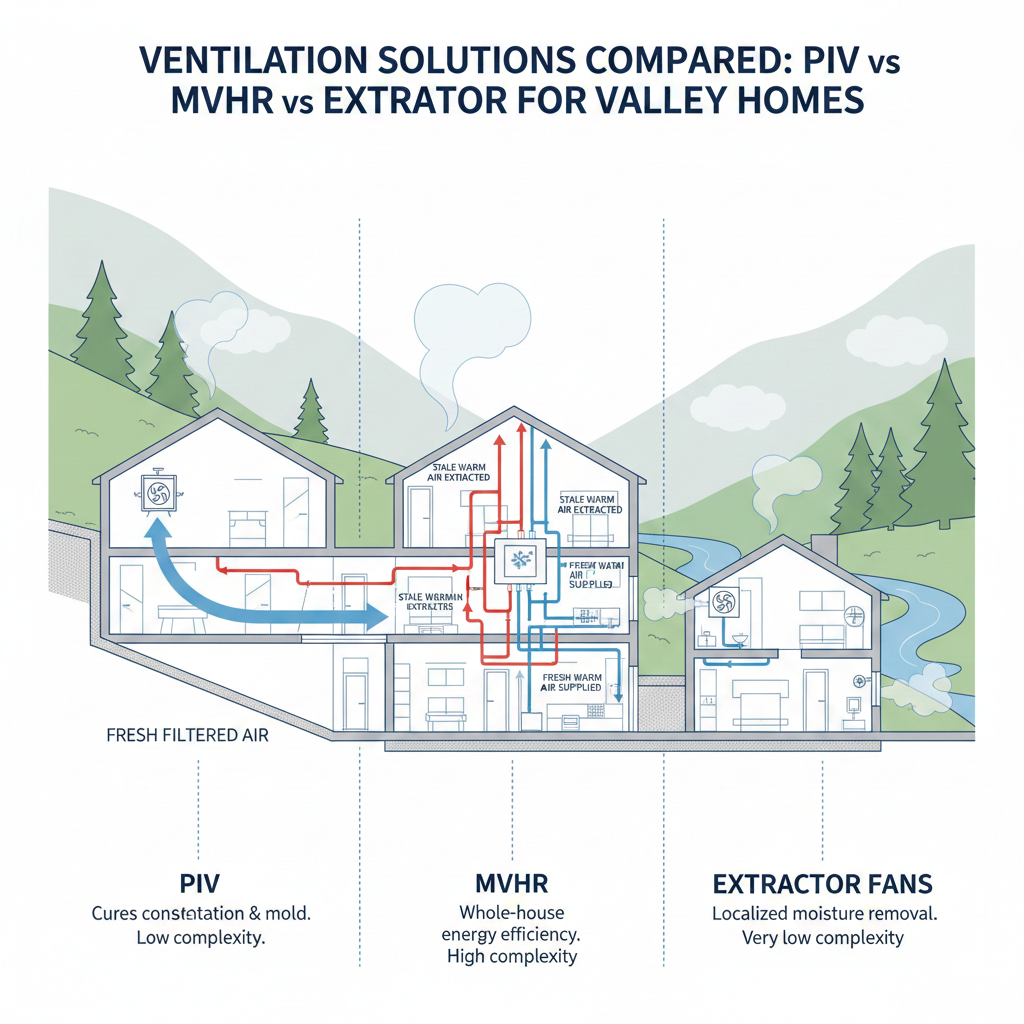
This is where the right ventilation system makes a real difference, because it controls moisture at the source instead of just wiping away mould patches. Positive input ventilation (PIV) systems push in a steady flow of filtered, fresh air from the loft, while mechanical ventilation heat recovery (MVHR) units extract stale air and recover warmth at the same time. In bathrooms and kitchens, good quality extractor fans help remove steam quickly, but on their own they rarely solve whole‑house condensation in South Wales valleys. You get the best results when a tailored mix of PIV, MVHR and effective extractor fans works with your specific property type and lifestyle.
PRBGE specialises in this joined‑up approach, combining expert damp proofing, condensation control and ventilation design for homes across Cardiff, Merthyr Tydfil and Rhondda Cynon Taf. Our team surveys the building fabric, checks existing extractor fans in bathrooms and kitchens, and then recommends positive input ventilation or mechanical ventilation heat recovery where it suits your budget and layout. Because PRBGE focuses on eliminating the root cause of moisture rather than covering it up, your walls stay drier, mould struggles to return and the air in your home feels fresher all year. If you want clear advice on which ventilation option fits your valley home, you can call PRBGE on 0333 335 6086 to book a local survey.
What is PIV? Ideal for Valleys Properties
Positive input ventilation, or PIV, is a simple whole‑home system that pushes a gentle flow of filtered fresh air into your property from a central unit, usually mounted in the loft. As this clean air enters and moves through the rooms, it creates a slight positive pressure, which helps drive out damp, stale air through natural gaps, trickle vents and small leaks in the building fabric. Because the incoming air is usually drawn from the loft, it is often slightly warmer and drier than the air in your rooms, so condensation on cold walls and windows starts to reduce over time.
For many South Wales valley properties, this makes PIV a strong fit, especially in older homes around Caerphilly and the Vale of Glamorgan that already have small natural air leaks. Terraced houses and traditional solid‑wall homes often struggle with constant condensation and black mould, yet a full ducted MVHR system may feel too disruptive or expensive, so a single loft‑mounted PIV unit can be a more practical choice. Once installed, PIV runs quietly in the background, uses low electricity and needs only basic filter changes, which helps keep running costs predictable for families. In many Cardiff homes, PIV ventilation systems work well when combined with decent bathroom and kitchen extractor fans, because the extra airflow gives moist air an easier escape route.
If you live in Newport and want affordable PIV installation without guesswork, PRBGE can survey your property and confirm whether positive input ventilation is the right option. The team checks loft access, existing damp or mould issues and how each room is used, then recommends a PIV unit size and setting that match your home and budget. Because PRBGE focuses on condensation control across Caerphilly, the Vale of Glamorgan, Cardiff and Newport, you get a system that targets moisture at its source rather than just treating surface mould. To discuss PIV ventilation systems for your Cardiff home or arrange an affordable PIV installation in Newport, you can call PRBGE on 0333 335 6086.
MVHR Systems Explained: Heat Recovery for Modern Builds
Mechanical Ventilation with Heat Recovery, or MVHR, is a whole‑house system that uses a network of ducts to continuously supply fresh air and extract stale air at the same time. Inside the central unit, a heat exchanger lets warm, humid air leaving the home pass by cooler fresh air coming in, so around 90% of the heat is recovered without mixing the two air streams. Filters on both the supply and extract sides remove dust, pollen and other pollutants, which means you get cleaner indoor air while still meeting modern UK ventilation and energy‑efficiency standards. Because MVHR runs continuously at a low rate, it stops moisture building up in wet rooms like bathrooms and kitchens and then spreading into bedrooms and living areas.
In modern, airtight new builds around Swansea and Port Talbot, MVHR is often the best match because these properties retain heat very well but do not breathe naturally. A simple extractor‑only setup can waste a lot of warm air in winter, while a correctly designed MVHR system keeps fresh air moving without pushing your heating bills too high. For high‑performance homes and developments in places like Bridgend, whole‑house MVHR also supports Building Regulations compliance and improves SAP scores, which helps both developers and buyers. When you compare MVHR vs PIV in South Wales valleys, MVHR usually suits newer, very airtight homes, while PIV works better in older, slightly draughty properties.
PRBGE designs and installs MVHR systems so they match the layout and use of each modern build, instead of relying on a one‑size‑fits‑all design. The PRBGE team plans duct routes, positions supply and extract valves in the right rooms and selects units with suitable heat recovery and filtration levels for Swansea, Port Talbot and Bridgend homes. Because PRBGE also focuses on condensation control and mould prevention across the South Wales valleys, your whole‑house MVHR setup protects comfort, air quality and long‑term building health. If you want to compare MVHR vs PIV for a new build or explore whole‑house MVHR for a Bridgend property, you can call PRBGE on 0333 335 6086 to arrange a local survey.
Extractor Fans: Basic Local Ventilation
Extractor fans are simple, room‑based ventilation units that pull moist, stale air out of a space and discharge it outside, usually through a short duct or wall vent. In most Blaenau Gwent and Torfaen homes, you see them in bathrooms above the shower or in kitchens near the hob, where steam and cooking moisture build up quickly. When they switch on with the light or a separate pull cord, they grab the warm, humid air and push it outdoors so it cannot condense on cold tiles, windows or ceiling corners. You can choose intermittent fans, which only run when needed, or continuous fans, which run quietly at a low speed all day with a boost mode for showers or heavy cooking.
Used properly, these humidity‑control extractor fans help reduce condensation and mould in key wet rooms, especially where there is no opening window. They improve local air quality, cut down on musty smells and protect paintwork, grout and timber from long‑term moisture damage. However, they only ventilate the room they are installed in, so they do not provide whole‑house coverage or any form of heat recovery, and they can waste warm air in winter. When you compare extractor fans vs MVHR in places like Monmouthshire, fans are cheaper and easier to fit, but MVHR gives continuous, filtered ventilation and recovers 70–90% of the heat from outgoing air.
For Neath homes that suffer with steamy bathrooms or damp kitchens, humidity‑controlled extractor fans are often a smart first step, especially alongside trickle vents and small behaviour changes. PRBGE frequently specifies modern low‑energy fans with timers or humidity sensors as part of a wider condensation control plan, so moisture is removed at the source while the rest of the home still feels comfortable. When a survey shows wider damp or mould problems across bedrooms and living areas, PRBGE may recommend combining upgraded extractor fans with PIV or, in some cases, MVHR to protect the whole property. If you want to understand whether simple extractor fans are enough for your Blaenau Gwent, Torfaen, Monmouthshire or Neath home, you can call PRBGE on 0333 335 6086 to arrange a local ventilation survey.
PIV vs MVHR vs Extractor Fans: Feature Comparison Table
| Feature | PIV | MVHR | Extractor Fans |
| Whole-House Coverage | Yes | Yes | No (local only) |
| Heat Recovery | No | Up to 90% | No |
| Installation Cost (South Wales) | Low (£400-£800) | High (£3k-£8k) | Lowest (£100-£500) |
| Best for Valley Homes | Older, draughty (Rhondda) | Airtight (Cardiff new builds) | Kitchens/bathrooms (Swansea) |
| Energy Savings | Moderate | High | Low |
| Mould Prevention | Good | Excellent | Basic |
Key Differences: Which Wins for South Wales Homes?
For most occupied Cardiff and Newport homes, PIV tends to be the most budget‑friendly whole‑house option, with lower installation costs and very low running expenses. A typical PIV unit is quick to retrofit with minimal disruption, needs only simple filter checks and costs roughly pennies per day to run, which suits families in older valley properties. MVHR, by contrast, has a higher upfront cost because it needs full ductwork and careful commissioning, but it can significantly cut heating losses over time in airtight homes, which appeals to some newer Cardiff developments. Traditional extractor fans remain the cheapest and simplest option, yet they only ventilate single rooms and provide no heat recovery, so they rarely solve whole‑house damp on their own.
Noise and maintenance also differ between systems, which matters in compact South Wales terraces and flats. PIV units are usually mounted in lofts or hallways and are designed to run very quietly, with straightforward filter changes and little else to worry about. MVHR systems can be extremely quiet when specified and balanced correctly, but they do require regular filter replacements and occasional checks of fan performance and airflows. Extractor fans can be almost silent in modern continuous‑running versions, though older intermittent fans may hum or rattle, and they need periodic cleaning to keep performance and noise under control. For many South Wales valley homes with stubborn condensation, the practical answer is often PIV plus upgraded extractor fans, with MVHR reserved for well‑insulated, airtight properties.
PRBGE uses these differences to recommend the best fit for each property instead of pushing a single “winner” system. In a typical older Cardiff or Newport terrace with high humidity but limited budget, PRBGE might suggest PIV as the main background ventilation, paired with quiet, modern bathroom and kitchen extractor fans. Where a newer or heavily refurbished home is already very airtight, PRBGE is more likely to design an MVHR system that balances energy efficiency, noise and air quality for the long term. This tailored approach helps South Wales homeowners tackle valley damp, reduce black mould risk and keep running costs predictable.
Ventilation and Mould Removal in South Wales
In Merthyr Tydfil, Caerphilly and other valley areas, poor ventilation is one of the main reasons black mould keeps returning on bedroom walls, ceilings and window reveals. Warm, moist air from daily life hits cold external walls and condenses, which feeds mould spores and leads to the familiar dark patches, peeling paint and musty odours. Even if you clean the surface, the mould often comes back because the underlying moisture problem remains and the air still cannot escape properly. That is why long‑term protection depends on a mix of safe mould removal, better ventilation and improved condensation control, not just one‑off treatments.
PRBGE acts as a specialist black mould removal and condensation control provider across South Wales, including “mould removal services near me” searches in Cardiff and nearby towns. The team carries out professional mould surveys to identify the cause of growth, then uses safe remediation methods to remove mould from walls, ceilings, joinery and hidden voids. Alongside this, PRBGE can install or upgrade ventilation systems such as PIV, MVHR or high‑performance extractor fans, so the air stays drier and mould struggles to return. For landlords and businesses that need commercial mold remediation in Newport or professional mould removal in Swansea, PRBGE also offers tailored treatment plans that minimise disruption while addressing both health and property risks.
Because PRBGE focuses on root‑cause moisture control, their mould removal projects always link back to ventilation, humidity and building fabric, rather than quick cosmetic fixes. This integrated approach helps valley homes move from reactive bleach wipes to stable, long‑term protection against black mould.
Why Choose PRBGE Ventilation Solutions Locally
PRBGE specialises in eliminating moisture at its source in Cardiff, Newport and Swansea by combining expert PIV and MVHR installations with targeted condensation control. From Merthyr Tydfil and Rhondda Cynon Taf through Caerphilly and the Vale of Glamorgan, PRBGE surveys each property carefully, checking humidity levels, cold spots, existing ventilation and insulation before recommending any system. In Newport, Blaenau Gwent, Torfaen and Monmouthshire, the team can design ventilation upgrades that fit your budget, whether that means affordable PIV, whole‑house MVHR, high‑performance extractor fans or a mixture of all three.
Homeowners in Swansea, Port Talbot, Neath and Bridgend benefit from the same local expertise, with free surveys often available for valley properties that clearly struggle with condensation and mould. Because PRBGE operates across the South Wales region, you get consistent advice, proven systems and joined‑up damp, mould and ventilation solutions under one roof. The focus stays on long‑term performance and healthier air, rather than short‑term patch repairs. If you need tailored ventilation design and installation for your valley home, you can call PRBGE on 0333 335 6086 to discuss options and arrange a survey.
Conclusion
The best ventilation choice for a South Wales valley home depends on how old the property is, how airtight it has become and how severe the condensation or mould problems are. A professional survey is the safest way to decide between PIV for retrofits, MVHR for energy‑efficient new builds and targeted extractor fan upgrades for key wet rooms.
PRBGE offers these surveys across Cardiff, Newport, Swansea and the surrounding valleys, combining ventilation design with expert mould and damp control. To find the right solution for your Valley Home and protect your family from ongoing mould and moisture, contact PRBGE today on 0333 335 6086.
